
Our Publications

A curated collection of Digital Health and Rights Project peer-reviewed journal articles, reports, policy briefs, and more for in-depth exploration.

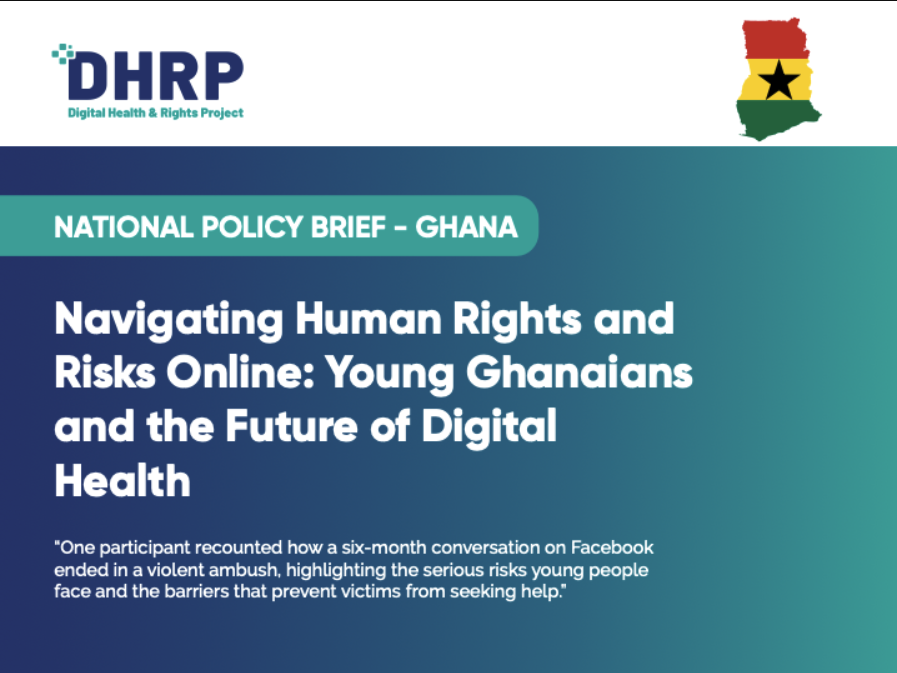
National Policy Brief – Navigating Human Rights and Risks Online: Young Ghanaians and the Future of Digital Health

Digital Health and Rights Project

This national policy brief examines how young people in Ghana navigate digital spaces to access health information, with a focus on human rights and exposure to online risks. Drawing on participatory research, it highlights experiences of online harms and abuse, misinformation, and privacy concerns affecting young key populations. It finds that marginalised young adults face significant economic barriers, particularly the high cost of mobile devices and internet data, limiting access. Stigma related to health status, gender identity, and occupation further discourages engagement. These intersecting risks deepen exclusion, underscoring the need for inclusive, rights-based digital health policies that ensure safe, affordable, and equitable access.

Checklist For Assessing Gender, Equity and Rights Inclusion in Developing Digital Health Strategies

Tara Imalingat + et al

This Checklist for Assessing Gender, Equity and Rights Inclusion in Developing Digital Health Strategies is a practical tool developed to encourage reflection and debate among officials, consultants, civil society and other stakeholders to ensure digital health strategies advance human rights, gender equality and inclusion approaches to the adoption and management of digital health technologies. It includes a list of UN guidance and other resources to help inform the strategy development process.

Paying the Costs of Connection : Vietnam Policy Brief

VNP+

This brief explores digital health and rights issues, reviews the current policy landscape, identifies gaps, and offers recommendations to internet users—especially young adults living with HIV or from marginalized communities (who are even more vulnerable than they already are, due to the fear of data leak, exposure, stigma, digital divides, and absence of in-person support), as well as government authorities, NGOs, and donors. These recommendations, informed by the study Paying the costs of connection: Human rights of young adults in the digital age in Colombia, Ghana, Kenya and Vietnam”, conducted by the Digital Health and Rights Project (DHRP) and funded by Fondation Botnar, aim to ensure young adults can engage safely, responsibly, and meaningfully in the digital space.

Paying the Costs of Connection : Global Policy Brief

Digital Health and Rights Project + et al

In 2025, DHRP published ‘Paying the costs of connection: Human rights in the digital age in Colombia, Ghana, Kenya and Vietnam’. The report explores young adults’ experiences and opinions of the digital transformation and how it affects their health and human rights. As it uses a participatory action research approach, it helps fil a gap in current knowledge and practice, as young people are often left out of decision-making and policy discussions that affect their lives.

Our findings highlight four key themes demonstrating that many factors interconnect to shape young adults’ experiences of human rights in the digital age in Colombia, Ghana, Kenya and Vietnam.

Research article: Digital health and human rights of young adults in Ghana, Kenya and Vietnam: a qualitative participatory action research study

Georgina Caswell + et al

This article from BMJ Global Health draws on DHRP's first participatory action research study in Ghana, Kenya and Vietnam in 2021-22 to investigate the impact of the digital transformation on health of diverse young adults.

Commentary: Political determinants of digital health: beyond the rainbow

Sara L.M. Davis

This essay draws on the HIV response to critically engage with recent literature on the digital determinants of health, proposing an approach to analyzing broader political determinants of health, including commercial determinants of health, and other laws, policies, governance, and civic engagement relevant to digital health strategies. By rendering visible the role of politics, governance, and civic engagement in digital health, strategies can be tools to mobilize broad collaborations and advocacy that creates an enabling environment.

A Guide to Digital Health and Human Rights in Global Fund Grant Cycle 8

Molly Pugh-Jones

The Global Fund to Fight AIDS, Tuberculosis and Malaria (The Global Fund) is approaching a new grant cycle. Grant Cycle 8 (GC8) will run for three years between 2026-2028 and there are a number of key ways that communities and civil society can input into the process. The purpose of this guide, produced by STOPAIDS and DHRP is to support communities and civil society in navigating digital health rights in GC8 documents and processes.