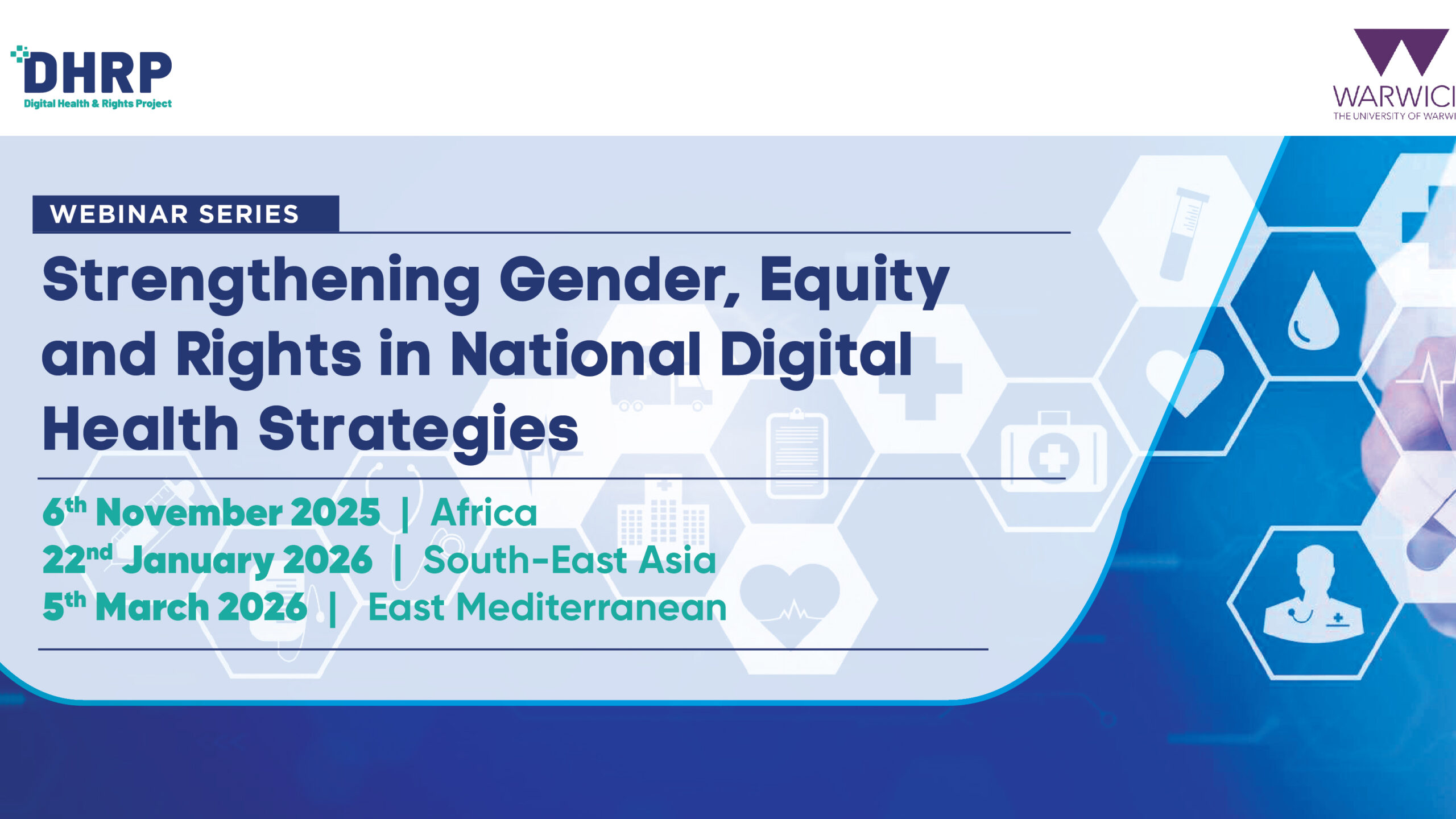
Strengthening Gender, Equity and Rights in National Digital Health Strategies: Three online conversations

Many countries are developing their first national digital health strategies––an exciting opportunity to leap towards modernizing healthcare, leveraging digital tools and the power of artificial intelligence for all. But: are officials thinking about how gender inequalities and unmet needs of other diverse groups might undermine digital access and inclusion?

In 2025-26, we plan a series of online conversations with diverse voices: government, private sector, UN, youth and civil society – to think through the specific challenges and needs of diverse regions, and to spark a multidisciplinary dialogue on the integration of Gender, Equity, Rights, and Inclusion into the governance of digital health and AI for health.

We’re drawing on these tools:

  • Our 2024 report found that not one of the 20 national strategies reviewed explicitly incorporated gender equality, human rights, or considerations for marginalized populations. This omission poses a significant risk that digital transformation may exacerbate existing health inequities
  • Our new collection of UN guidance on digital health, gender equality and human rights
  • Checklists and other tools are on their way!

Previous sessions in this series,

  • Strengthening Gender, Equity and Rights in National Digital Health Strategies in Africa: 6 November 2025

Future Sessions in this Series:

  • Strengthening Gender, Equity and Rights in National Digital Health Strategies in South-East Asia: 22 January 2026
  • Strengthening Gender, Equity and Rights in National Digital Health Strategies in the Eastern Mediterranean/MENA region: 5 March 2026

Please register and disseminate this invitation with others who may be interested!

Register for the webinars here: https://forms.office.com/e/f4nCEPGeBc

We look forward to hearing your voice!

Digital Health Week Webinar: Strengthening Gender, Equity and Rights in National Digital Health Strategies in South-East Asia

DATE: Thursday, 22nd January 2026

TIme 10:00am-11:30am GMT / 5:00pm-6:30pm ICT, WITA/ 6:00pm-7:30pm SGT/ 7:00pm-8:30pm TLST

PLATFORM: Online (Link provided upon registration)

REGISTER: https://forms.office.com/e/f4nCEPGeBc or email [email protected] to sign up!

Dr. Khine Su Win is a medical doctor and dedicated global health professional with over a decade of experience advancing human rights and gender equality across Asia. Since 2012, she has focused on supporting marginalized communities, including People Living with HIV (PLHIV), Women Living with HIV (WLHIV), LGBTIQ individuals, sex workers, People Who Use Drugs (PWUD), opium farmers, and ethnic minorities. With expertise in program and financial management, strategic planning, participatory research, monitoring and evaluation, and capacity building, she designs and implements inclusive, evidence-based initiatives that empower communities and promote social justice. Currently, she serves as Strategic Development Director at ILGA Asia, where she leads regional efforts to advance LGBTIQA+ rights. Driven by a passion for equity and inclusion, Khine advocates for policies and programs that amplify marginalized voices, improve well-being, and foster societies where every individual is recognized, respected, and supported to thrive.


Ramla Khalidi has been the Resident Representative of UNDP in Vietnam since September 2022.

She has over 30 years of experience working in development and policy research at both the national and regional levels, including 25 years with UNDP and the UN Secretariat. Ms. Khalidi has managed programme focused on delivering early recovery and resilience support through the creation of livelihoods opportunities, the rehabilitation of critical social infrastructure, and the promotion of social cohesion.

Ms. Khalidi has led the interdisciplinary and strategic planning efforts of the UN Economic and Social Commission for Western Asia on the 2030 Agenda and the SDGs, and managed the organization’s technical cooperation programmes and policy advisoryservices. Ms. Khalidi’s policy work has focused on poverty reduction, inclusive social development, gender equality and good governance. Ms. Khalidi is a national of Jordan. She holds a Master of Arts in Arab Studies and a Bachelor’s degree in International Relations.

 I have been active in HIV prevention and control since 2019, focusing on young people affected by HIV in Vietnam. And I work involves capacity building, education on HIV/AIDS treatment, and reducing stigma and discrimination. I currently serves as a community representative for people living with HIV on the CCM Vietnam.
Brief : As the Youth Program Coordinator at VNP+, I lead activities, including communication  knowledge sharing, and capacity building related to treatment, medication access, and stigma reduction for young people living with HIV in Vietnam.

Tara Imalingat is a global health and human rights lawyer and researcher passionate about advancing human rights-based, equitable and inclusive digital health governance in low- and middle income countries. She works as the Advocacy and impact coordinator at the University of Warwick’s Centre for interdisciplinary Methodologies (CIM) for the Digital Health and Rights Project (DHRP), an international research and policy consortium that uses transnational participatory action research to produce evidence to inform national and global health governance.

Meg Davis is Professor of Digital Health and Rights at the Centre for Interdisciplinary Methodologies (CIM), University of Warwick. She is also Research and Impact Director for CIM. She co-founded and serves as project lead for the Digital Health and Rights Project consortium. Her most recent book is The Uncounted: Politics of data in global health (Cambridge 2020).