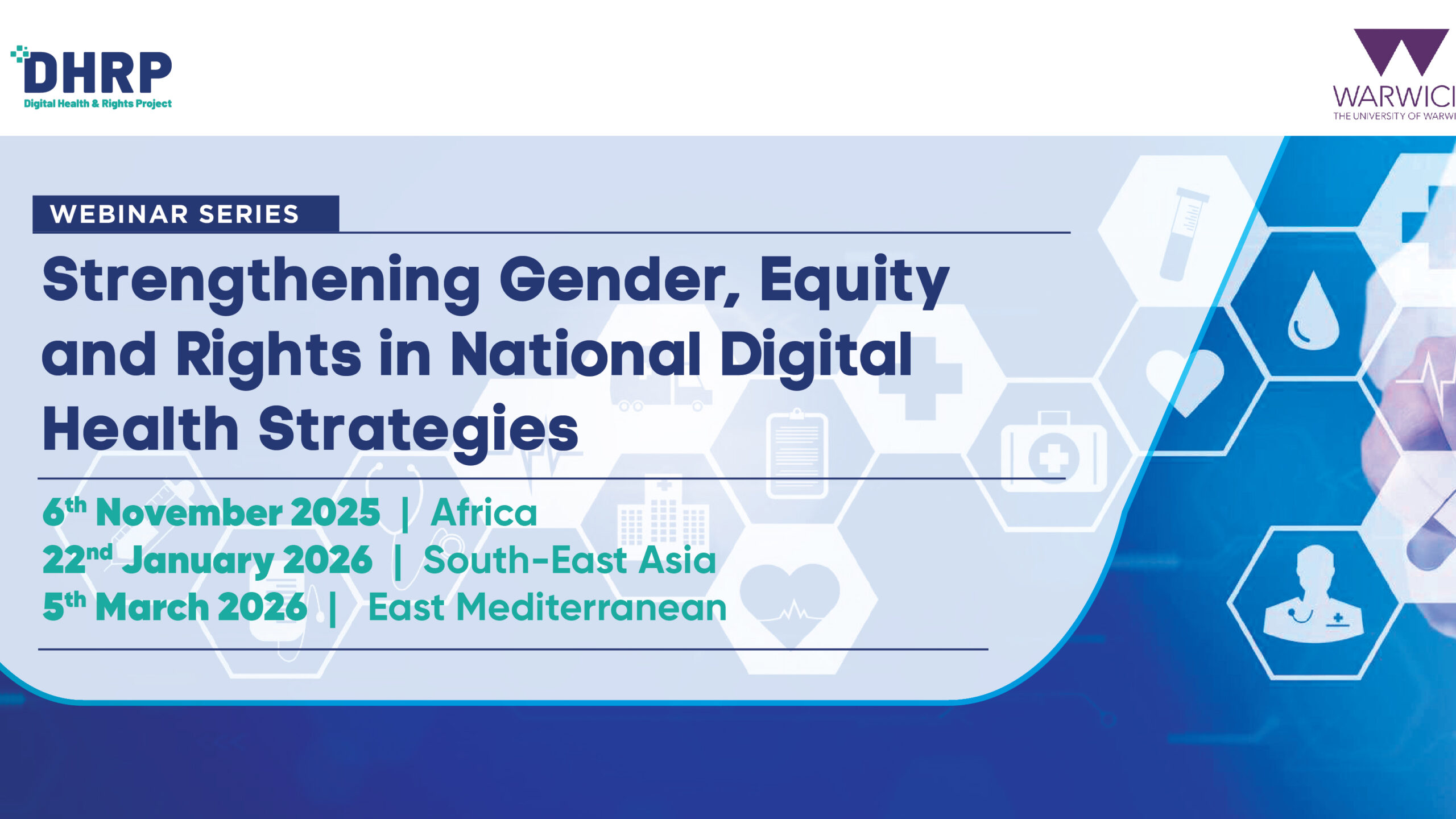
Strengthening Gender, Equity and Rights in National Digital Health Strategies: Three online conversations

Many countries are developing their first national digital health strategies––an exciting opportunity to leap towards modernizing healthcare, leveraging digital tools and the power of artificial intelligence for all. But: are officials thinking about how gender inequalities and unmet needs of other diverse groups might undermine digital access and inclusion?

In 2025-26, we plan a series of online conversations with diverse voices: government, private sector, UN, youth and civil society – to think through the specific challenges and needs of diverse regions, and to spark a multidisciplinary dialogue on the integration of Gender, Equity, Rights, and Inclusion into the governance of digital health and AI for health.

We’re drawing on these tools:

  • Our 2024 report found that not one of the 20 national strategies reviewed explicitly incorporated gender equality, human rights, or considerations for marginalized populations. This omission poses a significant risk that digital transformation may exacerbate existing health inequities
  • Our new collection of UN guidance on digital health, gender equality and human rights
  • Checklists and other tools are on their way!

We plan three episodes, with the inaugural session focusing on the African region, where 38 of 47 Member States have now established national digital health strategies.

Future Sessions in this Series:

  • Strengthening Gender, Equity and Rights in National Digital Health Strategies in South-East Asia: 22 January 2026
  • Strengthening Gender, Equity and Rights in National Digital Health Strategies in the Eastern Mediterranean/MENA region: 5 March 2026

Please register and disseminate this invitation with others who may be interested!

Register for the webinars here: https://forms.office.com/e/f4nCEPGeBc

We look forward to hearing your voice!

Digital Health Week Webinar: Strengthening Gender, Equity and Rights in National Digital Health Strategies in Africa

DATE: Thursday, 6 November 2025
TIME: 14:00 – 15:30 GMT (15:00 CET / 16:00 EAT)
PLATFORM: Online (Link provided upon registration)
REGISTER: https://forms.office.com/e/f4nCEPGeBc
Or e-mail [email protected] to sign up!

Please find speaker bios below.
Alia El-Yassir is
the Director for Gender, Equity, Diversity, and Rights for Health at the World Health Organization, a role she assumed in May 2024. She also recently took on leadership of WHO’s efforts to prevent and respond to sexual misconduct. Prior to this, Alia served as UN Women’s Regional Director for Asia and the Pacific and Representative to the Kingdom of Thailand (2023–2024), and as Regional Director for Europe and Central Asia and Representative to the Republic of Türkiye (2018–2023). Her leadership has been instrumental in shaping gender-responsive policies and partnerships at regional and global levels.

Derrick Muneene is Unit Head, Digital Health Capacity Building and Collaboration, WHO

Dr. Sanjeev Pugazhendi is Lead, Policy, Planning and Development at the Ministry of Health of Seychelles. He is the focal point for digital health and information systems, and has led multiple health and information systems assessments. He is also focal point for health-related Sustainable Development Goals, including Universal Health Coverage and climate and health. He is currently leading planning for development of a digital health strategy for Seychelles in 2026.

Ndifanji is the Policy Manager at Transform Health, a global coalition of more than 215 organisations that advocate, campaign and build consensus to strengthen the enabling environment for the digital transformation of health systems to achieve Universal Health Coverage. Working closely with coalition partners, Ndifanji supports the development and delivery of the coalition’s policy and influencing work. She is the Vice Chair of Aidsfonds Advisory Panel. Ndifanji has a passion for youth development and she was previously the Youth Work stream Co-chair for RBM Partnership to End Malaria and Malaria No More UK Youth Ambassador. Ndifanji is a holder of a  Bachelor of Medicine; Bachelor of Surgery (MBBS) from the Kamuzu University of Health Sciences and an MBA from Heriot-Watt University.

James Kiilu is a medical doctor in Kenya with a deep interest in global health and community participation. He is a member of the Kenya Community Advisory Team (K-CAT) for the Digital Health and Rights Project. He previously served as a youth advocate at the Centre for the Study of Adolescence. He also serves as Director of Outreach at the Integrated Cancer Research Foundation.

Meg Davis is Professor of Digital Health and Rights at the Centre for Interdisciplinary Methodologies (CIM), University of Warwick. She is also Research and Impact Director for CIM. She co-founded and serves as project lead for the Digital Health and Rights Project consortium. Her most recent book is The Uncounted: Politics of data in global health (Cambridge 2020).